
Memorial Health Sleep Medicine
We can help you get your sleep back
Memorial Health Sleep Medicine specializes in the diagnosis and treatment of sleep disorders in adults. Every night, millions of people go to sleep hoping to wake in the morning rested and relaxed. However, for many, this is just not possible. They suffer from a sleep disorder.
Do You Have a Sleep Condition?
If your doctor suspects you have sleep apnea or another sleep disorder, they will prescribe a sleep study in a sleep lab. Patients typically arrive at the sleep lab in the early evening and leave the next morning. Each patient has a comfortable, private room. Our objective is to provide a natural sleeping environment with hotel-like accommodations.
The sleep study, also called a polysomnogram, records brain activity, eye movement, oxygen and carbon dioxide blood levels, heart rate and rhythm, breathing rate and rhythm, the flow of air through your mouth and nose, snoring, body muscle movements, and chest and belly movement. The results are used to determine if you have one or more of the 80 sleep disorders that can interfere with your good night’s sleep.


Types of Sleep Disorders
There are many different types of sleep disorders, most of which are not recognized by the people who suffer from them. Sleep disorders are increasing every day in the United States and other countries. They are becoming the most frequent reasons for automobile accidents in the United States. If untreated, sleep disorders can cause other health-related problems, including heart attacks, strokes, congestive heart failure, and contribute to the severity of other diseases.
Some of the most common sleep disorders include:

REM Behavior Disorder
REM Behavior Disorder includes sleepwalking and even acting out your dreams. This is also a more rare sleep disorder. It can also be hereditary and is common in adolescents and teenagers. Although not common in adults, if this disorder is present, it indicates a more serious problem that should be treated.
Periodic Limb Movement Syndrome
Symptoms of Periodic Limb Movement Syndrome include involuntary twitching of the arms or legs, often during sleep. The frequent movement of the arms and legs disturb a person’s sleep and cause symptoms of tiredness in the morning. This disorder is common for people who already have restless leg syndrome.
Shift Work Disorder
Shift Work Disorder includes symptoms of insomnia and tiredness and is due to the body not being able to have a regular sleep cycle. It is common in many people who work at night or change work shifts frequently.
Insomnia
Difficulty in falling asleep and staying asleep is known as Insomnia. It can be caused by stress, excitement about an upcoming event or worry and should not be a long term problem. People who experience insomnia frequently may have another problem causing the insomnia events. Insomnia can also be caused by other sleep disorders
Obstructive Sleep Apnea
Obstructive Sleep Apnea is one of the most common sleep disorders people have today. It occurs when the tissues and muscle, in a person’s upper airway cause an obstruction. These excessive tissues or muscles of the airway relax and fall back closing off the airway and breathing for 10-90 seconds at a time. As the airway is closed off several times, a person’s sleep is interrupted during the night as well. When a person’s sleep is interrupted many times during the night, it becomes difficult to have a deep restful sleep.
Pediatric and Adolescent Sleep Disorders
Pediatric sleep disorders are very common, occurring in up to 30 percent of children, with significant adverse impact upon the child and/or the entire family. All of the sleep disorders that affect adults have a pediatric counterpart. The most common problems are of the sleep/wake schedule (difficulty falling or staying asleep, or inability to sleep at desired times). Infants and children also suffer from sleep apnea. Narcolepsy typically begins in adolescence and may affect younger children. Unusual motor behavior during sleep may result from night terrors, sleepwalking or nocturnal seizures.
Narcolepsy
Narcolepsy is a less common type of sleep disorder. It includes symptoms of excessive sleepiness, hallucinations just before and after sleep, muscle weakness and sometimes paralysis with increased emotional events. Some who suffer from this disorder may also experience an inability to move for several minutes after waking. It can be hereditary and is most common in people between the ages of 18-30. It is treatable with medication.
Excessive Daytime Sleepiness
Sleep deprivation is a condition that can be either acute or chronic and caused by a lack of sufficient sleep. Sleep deprivation will inevitably lead to a condition called excessive daytime sleepiness (EDS). EDS affects approximately 20% of the population and its contributing factors are insufficient sleep, sleep disorders and insomnia.
Conditions of Sleep Deprivation
Excessive daytime sleepiness’s major contributing factor are sleep disorders, which include Obstructive Sleep Apnea (OSA), Periodic Limb Movements (PLM’s) and other parasomnias that occur during sleep. EDS caused by these types of disorders require the person come into a sleep disorders center in order to have formal diagnosis performed so that proper treatment can then be instituted in order to correct these problems. Most of these conditions can be easily treated with either medications or, in some instances, such as obstructive sleep apnea, with therapy known as CPAP (continuous positive airway pressure). It is estimated that over 45,000 people a year die prematurely from obstructive sleep apnea. OSA eventually leads to hypertension, which then leads to congestive heart failure, heart attack or stroke.
Does EDS increase the amount of injuries?
In a recent study that has been performed, employees with EDS had almost double the amount of injuries incurred over a two year period. The percentage was increased even higher when the employees worked in a high noise level environment with an increase of over 50%. EDS is also known to affect people’s mood, making the person much moodier when they are overtired.
How does EDS affect us?
EDS affects humans by slowing the process of the brain to responses, decreased reaction time, reduced accuracy of short-term memory and moodiness. This leads to human error and dramatically increases the risk of accidents. It is estimated over 40% of all fatal car accidents are caused by EDS.
What causes EDS?
EDS, as caused by insufficient sleep, is a relatively easy condition to fix. Studies have shown a good proper night’s sleep usually will take care of all the problems that come from excessive daytime sleepiness. EDS caused from poor sleep hygiene requires the person to be vigilant in correcting the situations causing the poor sleep hygiene and to try to turn those around so they can have proper sleep.
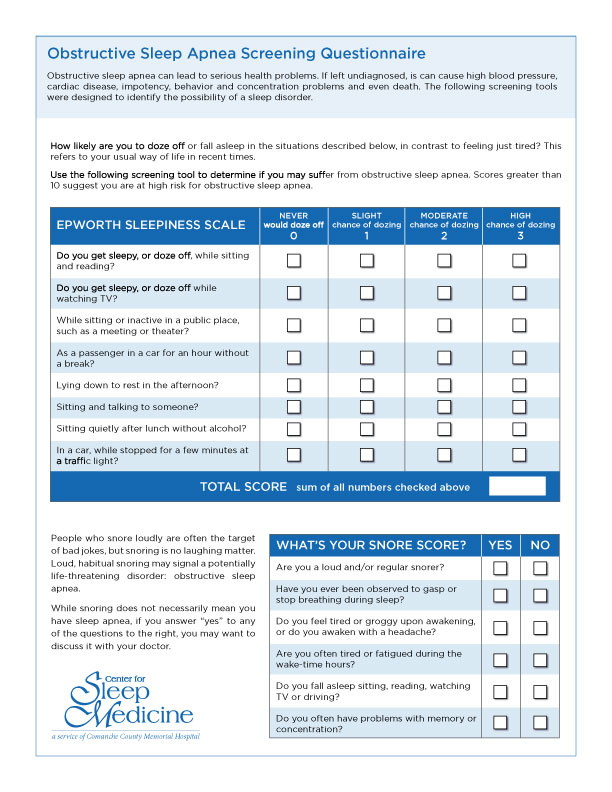
Sleep Apnea Screening Tool
Answer the following questionnaire to identify the possibility of a sleep disorder. If you score higher than a 10 in the first section and answer “yes” to any of the questions in the second section, you may want to discuss it with your doctor.
PLEASE NOTE: This form is a tool and is NOT a diagnosis. If you meet the criteria listed above, please make an appointment to discuss the results with your Memorial provider.
Effects of Obstructive Sleep Apnea
Blood Pressure
OSA can greatly increase blood pressure during an apnea.
Alertness
OSA can cause a decrease in alertness due to fragmented sleep and poor sleep quality.
O2 Sats
OSA will cause oxygen saturations to drop after an apneic event.
Mood
OSA can greatly effect mood by disrupting REM stage and from fatigue.
Weight
OSA can cause a gradual increase in weight due to slowed metabolism and decrease in activity.
Pulse
OSA can cause bradycardia during an apnea and then tachycardia after the event.
Headache
OSA can cause an increase in early morning headaches due to a buildup of CO2.
Tips for Better Sleep

Build Up Your Need For Sleep
- Avoid Naps – if you must nap, limit it to 10-25 minutes and only after you have been awake for at least 8 hours.
- Don’t Over Sleep – too much time in bed can make it harder to sleep the next night.
- Exercise – go for an exercise that makes you sweat. Do it for at least 30-40 minutes, do it at least 6 hours before bedtime.
- Heat Up Before Bed – try a hot bath or hot drink (no caffeine) within 2 hours before bedtime.

Time and Light
- Get Out of Bed – same time every day.
- Get Early Light – sunshine or very bright light within 30 minutes after getting out of bed.
- Keep It Dark at Night – avoid bright light if you have to get up at night.

Tobacco, Alcohol and Caffeine
- Don’t smoke at all, if possible.
- Don’t smoke after 7:00 pm.
- Don’t smoke at night.
- Avoid caffeine completely for 1 month, if possible.
- Limit caffeine to 3 doses or less before 10:00 am.
- Keep alcohol use light – alcohol breaks up the second half of your sleep cycle.
Avoid arousing stuff
- Keep your clock turned away from your bed.
- Avoid strenuous exercise 6 hours before bedtime.
- Keep food and drink very light for 3 hours before bed.
- Keep your bedroom dark, quiet and just the right temperature.
- Eyeshades and earplugs are OK to use.
- Get a bed and pillow just right for you.
- Bed is for sleep or sex only – No working in bed!
- Create a bedtime ritual.
- Learn some relaxation techniques.
- Make to-do lists, then set the list aside for morning.
- Let worry go.
- Forgive yourself and others.
Contact Us

Phone

Address
Lawton, OK 73505